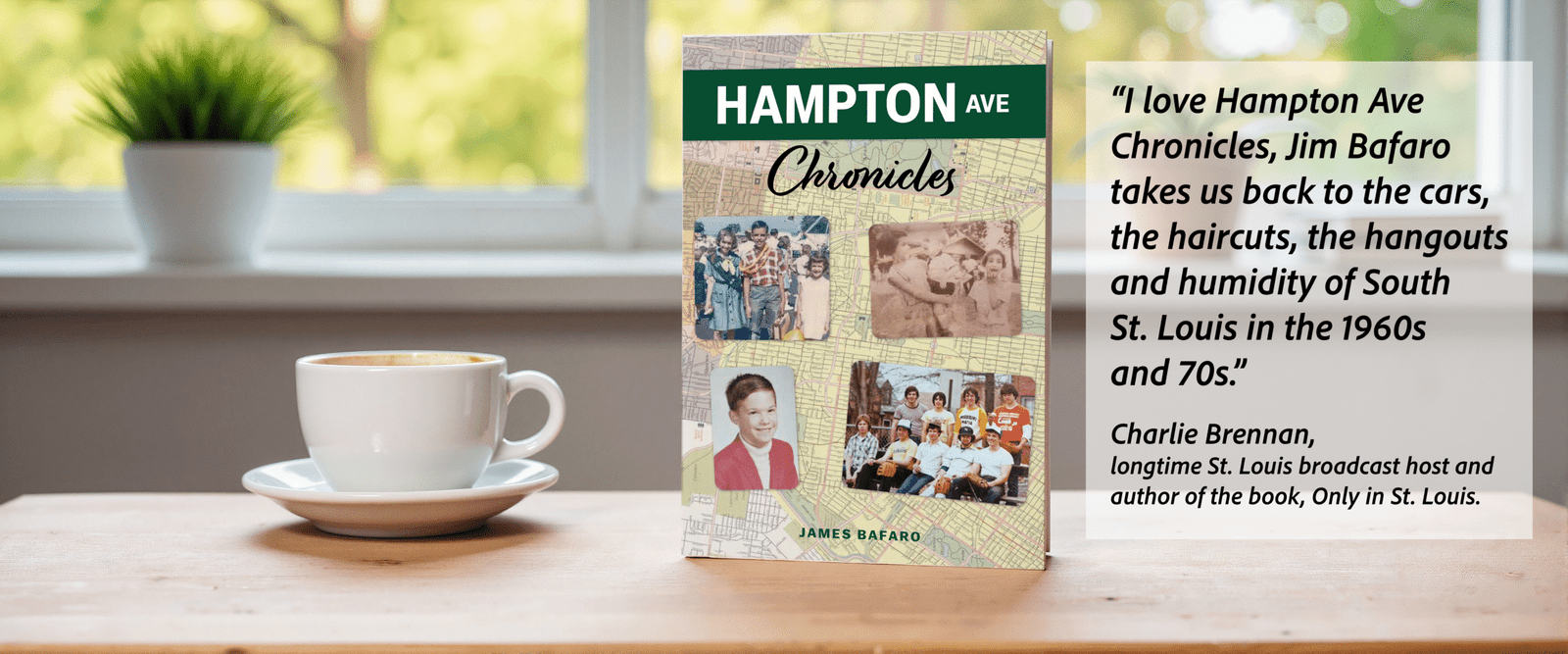
Hampton Avenue Chronicles is collection of personal stories of growing up in South St. Louis in the 1960’s and 1970’s, as recounted by author James Bafaro.
A longtime St. Louis radio and online newsperson, (KMOX/WIL/KTRS/NPR and the St. Louis Business Journal), Bafaro tells entertaining and true tales of a young boy coming of age in the South St. Louis neighborhood near Hampton Avenue – a five-mile stretch of north-south roadway in the middle of the city that connected the good, the bad, the sometimes sad, and often humorous stories of a St. Louis child of the 60’s and 70’s.
Hampton Avenue Chronicles is the perfect antidote to the endless stream of negative news we see on social media – a book to keep at your bedside, or take to the pool or beach. A collection of fun, sometimes poignant, sometimes inspiring stories that bring readers back to why they read in the first place: to relax and experience a little escapism.
Written in a conversational style by a veteran reporter who has penned thousands of news stories over a 30-year career in and around journalism, Hampton Avenue Chronicles will return readers to a simpler time, with personal recollections of iconic St. Louis people, places and events from the era.  
It will have them smiling and reaching back to their own childhood, often evoking a reaction of, “oh yeah, I remember that!”

Reviews

Don’t take our word for it – here’s what our readers say:

Wendy Wiese

“Donnybrook” Nine PBS

“In a world where we can frequently feel lost, Jim Bafaro proves
you can go home again. Hampton Avenue Chronicles is a one-way
ticket back to each reader’s very own Goethe Avenue. So, grab your
magic marker, pour yourself a scotch and turn on the hi-fi, Al Martino
awaits! You won’t be able to put this book down and you’ll never
want to leave.”

Charlie Brennan

St. Louis broadcast host and author of the book, Only in St. Louis.

“I love Hampton Avenue Chronicles. Jim Bafaro takes us back to the cars, the haircuts, the hangouts, and humidity of South St. Louis in the 1960s and 70s. In the tradition of A.E. Hotchner, Bafaro details a lost St. Louis that was much harder, but in some ways, much better. If you lived through those times, you’re about to experience them again.”

Paul S. Heirendt

Publisher, Big River Media Group

The Street That Raised Us: Why Your Dad’s ’64 Chevy Bel Air Was Better Than an iPhone. 
If you grew up in America during the 1960s or 70s, you didn’t have GPS or an app to find your way home. You navigated your life by the smell of sautéed onions wafting from a White Castle, the neon hum of a giant soda bottle sign, or the terrifying, mechanical rattle of a roller coaster called The Screamin’ Eagle.
We all had a street that defined our universe. For James Bafaro, that street was Hampton Avenue in South St. Louis. But after reading his new book, Hampton Avenue Chronicles, I realized something: Hampton Avenue isn’t just a place in Missouri. It’s a timeline.
It’s the timeline of a childhood we can never go back to – and man, this book made me miss mine.
The World Before “Parental Controls”
Jim’s memoir is a love letter to a specific time and place, but if you squint, it’s a mirror for anyone who remembers when “social networking” meant shouting across the street to your best friend.
He takes us back to a world where safety regulations were merely suggestions. Remember the Rock-O-Planes? That terrifying cage-match of a carnival ride that Bafaro aptly renames “The Vomitorium”? We didn’t have mobile devices to distract us; we had the visceral terror of a carnival ride that seemed to be designed by a sadist, and we loved every second of it.
We had “The Playground” (The St. Louis Arena) and “The Fortress” (Busch Stadium). Today, kids have QR codes and digital tickets. Bafaro and his buddies had the unparalleled thrill of sneaking into the upper deck of a hockey game or “customizing” newspaper box placards with messages that would make a sailor blush. It was mischief, sure, but it was their mischief.
The Characters We All Knew
The heart of Hampton Ave Chronicles isn’t the concrete; it’s the people. Bafaro introduces us to a cast of characters that feel instantly familiar, like neighbors we haven’t seen in decades.
There’s his dad, Ernest: a World War II vet and “Chevy Man” whose vocabulary of curse words was “nuclear-level.” He was the kind of guy who bought a car without seatbelts because safety was optional, and who considered air conditioning a “luxury” even in the sweltering St. Louis heat. We all knew a dad like that – a man who worked hard, saved every penny, and expressed affection by threatening to leave you at a rest stop in Oklahoma.
Then there’s his mom, a dancer with a flair for the dramatic and a talent for malapropisms (calling gazpacho “Gestapo soup”).
These aren’t just Bafaro’s parents; they are the archetypes of a generation that built the suburbs and the city neighborhoods we grew up in.
Why We Look Back
There is a chapter in the book called “The Radio Room.” It describes Bafaro’s attic sanctuary where he listened to the world through the crackle of a multi-band receiver.
It struck me how different that is from today. Now, the world is in our pockets, screaming for attention 24/7. Back then, we to stop, we had to tune in. We had to listen at that moment or it was gone forever. Whether it was the Cardinals game on KMOX or the static-filled connection to a shortwave station in Europe, we earned our connection to the world and we appreciated it more.
Hampton Ave Chronicles is hilarious – you’ll laugh out loud at the story of the “Stolen Ball Affair” involving a Spirits of St. Louis basketball – but it’s also quietly heartbreaking. It reminds us that the Denny’s is gone. The Arena was imploded. The “knife sharpener man” doesn’t push his cart down the alley anymore.
But as long as books like this exist, those memories don’t have to vanish.
The Verdict
You don’t have to be from St. Louis to love this book (though if you know how to pronounce “Goethe” as GOH-thee or have ever “warshed a fark in the zink,” or driven on “highway farty far”, this is mandatory reading).
You just have to be someone who remembers the feeling of vinyl seats on a hot summer day, the taste of a 25-cent soda, and the freedom of a bicycle ride down the street that raised you.

Grab a copy of Hampton Ave Chronicles. It’s cheaper than a time machine, and the ride is a lot smoother.